


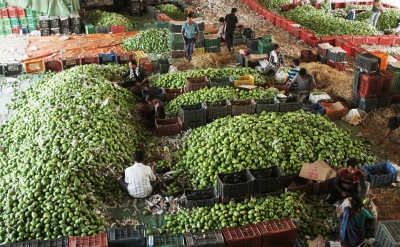
Indian mangoes have made a successful journey to Singapore through sea shipment, marking a significant advancement in expanding affordable mango exports to global markets. This achievement is set to pave the way for increased mango exports to countries like Singapore, Malaysia, Hong Kong, and others, with current imports valued at $4-5 million, and potential growth in markets like the UAE, estimated at $20–25 million.
The development of cost-effective sea shipment protocols is expected to bolster India’s mango export industry, leading to improved incomes for farmers, enhanced export competitiveness, and sustainable growth in the horticulture sector. Indian mangoes, particularly varieties like Banganappalli and Kesar, are highly sought after in Singapore for their exceptional taste, flavor, and quality.
To enhance export efficiency and competitiveness, the ICAR-Central Institute for Subtropical Horticulture (ICAR-CISH) in Lucknow, in collaboration with APEDA, has formulated a scientific sea shipment protocol for mango exports. In a recent initiative, 4.3 tonnes of Banganappalli mangoes from Andhra Pradesh were successfully exported to Singapore via a reefer container, offering a more cost-effective logistics solution compared to air shipment.
The sea route presents a significant reduction in logistics costs, estimated at Rs 13–20 per kg, in contrast to Rs 150–250 per kg for air shipment. This cost-effectiveness not only benefits producers and exporters but also ensures competitive prices for consumers abroad. The protocol developed by ICAR-CISH encompasses a comprehensive quality assurance system, covering residue-free production, Good Agricultural Practices (GAP), scientific harvesting, grading, packing, and post-harvest management.
