


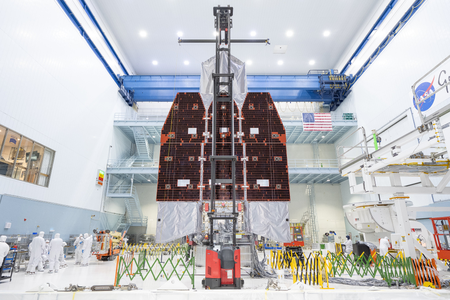
US space agency NASA introduced the Nancy Grace Roman Space Telescope, a wide-field observatory aimed at discovering planets beyond our solar system and investigating dark matter and dark energy. The telescope, named after NASA’s first chief astronomer, will have a field of view 100 times larger than the Hubble Space Telescope, potentially capturing light from a billion galaxies during its lifespan. Scheduled for launch by a SpaceX rocket in September at the earliest, the telescope will be moved to Florida for its journey into space.
The Nancy Grace Roman Space Telescope, costing over $4 billion and taking more than a decade to build, will be positioned 1.5 million kilometers away from Earth to explore vast regions of space. Situated at the second Sun-Earth Lagrange point, or L2, the telescope will benefit from gravitational forces that maintain steady orbits with minimal assistance, offering a significant improvement in data collection compared to the Hubble telescope. This observatory will be capable of blocking starlight to directly observe exoplanets and planet-forming disks, conduct a census of planetary systems in our galaxy, and address key questions in dark energy, exoplanets, and infrared astrophysics.
The Roman telescope’s advanced technology will enable it to send 11 terabytes of data to Earth daily, providing crucial insights into the universe. Mark Melton, a systems engineer at Goddard Space Flight Center, highlighted the thermal stability of the observatory at L2, which will greatly enhance the quality of data gathered by the telescope. With its ability to gather extensive data and explore the mysteries of the universe, the Nancy Grace Roman Space Telescope represents a significant advancement in space exploration.
