


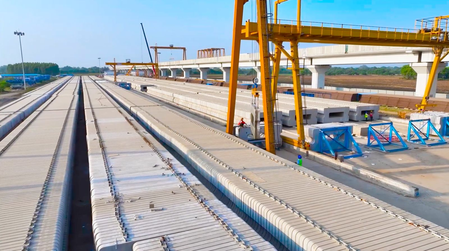
Track installation on the Mumbai-Ahmedabad high-speed rail corridor is advancing, with 185 route km of reinforced concrete track bed laid, 188 km of precast track slabs manufactured, and 70 km of slabs laid with cement asphalt mortar. This project introduces a J-slab ballastless track system based on the Japanese Shinkansen design to India for the first time.
The system consists of an RC track bed, Cement Asphalt Mortar (CAM), precast track slabs, and rails with fasteners designed for high-speed operations. To support this endeavor, two Track Slab Manufacturing Facilities (TSMF) have been set up at Kim near Surat and at Anand in Gujarat. These facilities produce high-grade concrete slabs with precise dimensions to ensure consistency across the corridor.
A total of 10 Track Construction Bases (TCBs) are currently operational, with four along the Surat-Bilimora-Vapi section and six between Vadodara-Anand-Ahmedabad. These bases aid in handling and installing rails, slabs, and specialized equipment required for track construction. The installation process is mechanized and adheres to Japanese construction practices, with most machinery being locally manufactured.
A Flash Butt Welding Machine (FBWM) is utilized to weld 25-meter-long, 60 kg rails into 200-meter panels at the construction bases on the viaduct. These welded panels undergo rigorous approval before being cleared for high-speed operations up to 320 kmph. Training and certification for rail weld finishing, inspection, and testing have been conducted by the Japanese company, JARTS, as a prerequisite for commencing welding work.
