


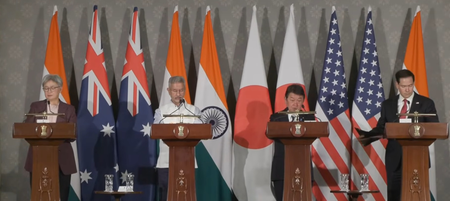
The Quad foreign ministers, representing India, the US, Australia, and Japan, emphasized trade, energy security, and maritime cooperation. They unveiled initiatives to bolster economic resilience and supply chain stability in the Indo-Pacific region. The meeting, chaired by India, saw discussions on key initiatives like maritime surveillance, port infrastructure, critical minerals, regional maritime coordination, and energy security.
External Affairs Minister S Jaishankar highlighted the growing significance of the Indo-Pacific for global economic activities and maritime trade. The ministers also addressed the collective stance against terrorism, emphasizing the need for zero tolerance and the right of nations to self-defense. The focus extended to fortifying supply chains and ensuring stability in maritime routes amidst escalating geopolitical uncertainties and energy security challenges.
US Secretary of State Marco Rubio described the Quad’s transformation into a proactive “partnership of action” aimed at tangible outcomes. The ministers aimed to shift from mere discussions to practical cooperation across various domains. Australian Foreign Minister Penny Wong underscored the economic repercussions of tensions in West Asia, particularly referencing concerns related to the Strait of Hormuz’s impact on energy security and regional economies.
Japanese Foreign Minister Toshimitsu Motegi reaffirmed the Quad’s commitment to promoting a “free and open Indo-Pacific” amid evolving global dynamics. The Quad, comprising India, the US, Australia, and Japan, has broadened collaboration in trade, technology, infrastructure, maritime security, and supply chains. The meeting signaled a strategic alignment towards a more cooperative and action-oriented approach within the Quad framework.
