


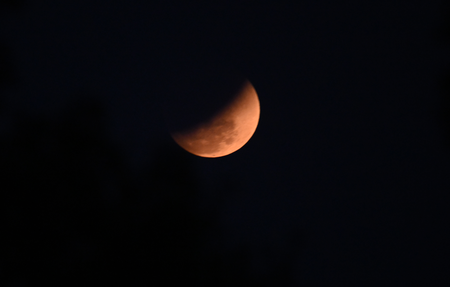
Skywatchers worldwide observed a stunning “total lunar eclipse,” commonly known as a “Blood Moon” for its reddish hue during totality. In India, the event, called “Chandra Grahan,” coincided with cultural festivities like Holi in some traditions, marking the first lunar eclipse of the year. A lunar eclipse occurs when the Earth aligns between the Sun and the Moon, casting a shadow on the lunar surface.
Observers in India experienced the eclipse starting at 3:20 p.m. with the penumbral phase, progressing to the partial phase and eventually totality. Due to the eclipse’s afternoon start, the Moon was below the horizon during the initial stages in India. Visibility improved after moonrise at 6:26 p.m., offering a view of the later eclipse phases until the event concluded at 6:47 p.m.
In regions like Indore, central and western India, the Moon rose during or after the maximum phase, displaying a captivating view of the red-orange eclipsed Moon against the twilight sky. Northeastern areas and islands may have witnessed more of the totality phase. The eclipse did not require special equipment for viewing, with naked-eye observation sufficient, though binoculars or telescopes enhanced the experience.
The eclipse coincided with the observance of ‘Sutak Kaal,’ an inauspicious period in Hindu customs, affecting activities from 6:20–6:23 a.m. till the eclipse’s end around 6:46–6:47 p.m. The event, a rare treat, was the final total lunar eclipse until late 2028, blending science and tradition beautifully through shared photos of the Blood Moon rising.
