


Celebrating India’s revolutionary freedom fighter | Understanding Netaji’s legacy and how the nation honors his birth anniversary
Every January 23rd, India pauses to remember a man who chose militant resistance over patient negotiation, who formed an army in exile rather than waiting for freedom to arrive through diplomatic channels. Subhas Chandra Bose Jayanti—officially designated as Parakram Diwas (Day of Valour) since 2021—honors a leader whose approach to independence was as controversial as it was consequential, whose mysterious disappearance in 1945 still fuels speculation, and whose legacy remains complex, powerful, and deeply relevant.
Quick Summary:
Subhas Chandra Bose Jayanti, celebrated January 23 as Parakram Diwas (Day of Valour), commemorates Netaji’s 1897 birth in Cuttack, Odisha. The day honors his formation of the Indian National Army (Azad Hind Fauj), his militant approach to independence, and his iconic call “Give me blood, and I shall give you freedom”—recognizing a revolutionary who believed armed resistance was essential to achieving true sovereignty.
Who Was Subhas Chandra Bose?
Before he became Netaji (“Respected Leader”), before he formed an army to fight the British alongside Axis powers, Subhas Chandra Bose was a brilliant scholar from Cuttack who cleared the Indian Civil Service examination but refused to serve the empire that ruled his country. That choice—walking away from prestige and security for principle—defined his entire trajectory.
Born January 23, 1897, to an affluent Bengali family, Bose attended prestigious institutions including Presidency College in Calcutta and Cambridge University. His academic excellence opened doors to comfortable colonial service. Instead, he chose the uncertain, dangerous path of revolutionary politics, eventually becoming one of the Indian National Congress’s youngest and most dynamic leaders before his ideological split with Gandhi’s non-violence approach.
What made Bose different from other freedom fighters:
- He believed non-violence alone couldn’t dislodge British rule; armed resistance was necessary
- He sought alliances with any power opposing Britain, including Nazi Germany and Imperial Japan
- He formed a government-in-exile (Azad Hind Government) and organized Indian POWs into the Indian National Army
- His slogan “Give me blood, and I shall give you freedom” represented militant nationalism versus Gandhi’s moral persuasion
- He envisioned economic independence alongside political freedom, not just transfer of power
Bose’s relationship with mainstream Congress leadership grew strained. After being elected Congress President in 1939 against Gandhi’s preferred candidate, political maneuvering forced his resignation. Disillusioned with what he saw as the movement’s timidity, he escaped British surveillance in 1941, traveled secretly through Afghanistan and the Soviet Union to Germany, then to Southeast Asia to organize resistance from abroad.
The Formation of Azad Hind Fauj: India’s Revolutionary Army
The Indian National Army wasn’t Bose’s original creation—it began with Indian POWs captured when Singapore fell to Japan in 1942. But Bose transformed it from a small group into a disciplined force of approximately 43,000 soldiers, including the Rani of Jhansi Regiment, one of history’s first all-women combat units.
Arriving in Singapore in July 1943, Bose galvanized the Indian diaspora in Southeast Asia. Shopkeepers, laborers, professionals donated jewelry, savings, even wedding rings to fund the INA. His charisma and vision convinced thousands that liberation was achievable, that they could fight for India’s freedom from foreign soil.
The Azad Hind Fauj’s key elements:
- Recruited from Indian POWs held by Japan after Malaya and Singapore campaigns
- Organized into infantry brigades, guerrilla units, and intelligence divisions
- Included the revolutionary Rani of Jhansi Regiment led by Captain Lakshmi Sahgal
- Fought alongside Japanese forces in Burma (Myanmar) campaign against British-Indian forces
- Hoisted the Indian tricolor in Moirang, Manipur—the first Indian territory “liberated” during the war
The INA’s military impact was limited—it faced logistical challenges, limited Japanese support once their position weakened, and devastating defeat in the Imphal campaign. But its symbolic impact was enormous. When British authorities tried INA officers for treason in the Red Fort trials of 1945-46, public outrage was so intense that naval mutinies and mass protests erupted, convincing the British that maintaining control over India was untenable.
Bose himself never saw independent India. His reported death in a plane crash in Taiwan on August 18, 1945, remains disputed by many who believe he survived and lived in secrecy. The mystery adds to his legend, but it also complicates his legacy—a man whose methods were controversial, whose alliances were troubling, but whose dedication to independence was absolute.
What Is Parakram Diwas and Why Was It Designated?
In January 2021, the Government of India officially renamed Subhas Chandra Bose Jayanti as “Parakram Diwas” (Day of Valour), linking the celebration explicitly to courage and militant spirit rather than just commemorating a birth anniversary. The redesignation came as part of broader efforts to highlight freedom fighters whose contributions were seen as underrepresented compared to Gandhi-Nehru lineage narratives.
“Parakram” translates to valor, courage, or prowess—qualities embodied by Bose’s approach to independence. Where Gandhi represented moral force and civil disobedience, Bose represented armed resistance and confrontational nationalism. Where Nehru represented parliamentary politics and internationalism, Bose represented militant patriotism and alliance with whoever opposed British imperialism.
The significance of the Parakram Diwas designation:
- Elevates Bose’s militant nationalism within official national memory
- Positions courage and sacrifice as values equal to non-violence in the independence struggle
- Appeals to those who see Gandhi’s non-violence as insufficient for achieving freedom
- Reflects contemporary political emphasis on assertive nationalism versus accommodationist approaches
- Provides counternarrative to Congress Party’s dominance in independence historiography
The timing matters politically. By 2021, the BJP-led government had been emphasizing figures they argued were marginalized by Congress-centric history—Sardar Patel, Ambedkar, Bose, and others. Parakram Diwas fits this pattern of reclaiming independence narratives, presenting Bose not as radical outlier but as essential contributor whose methods deserve equal respect.
For the diaspora, Parakram Diwas resonates differently. Many Indians abroad appreciate Bose’s global thinking, his ability to organize expatriate communities, his recognition that India’s freedom struggle wasn’t just domestic issue but international concern. The Southeast Asian Indian community he mobilized for the INA mirrors today’s global diaspora, making his legacy feel relevant to contemporary identity.
How India Celebrates Subhas Chandra Bose Jayanti
January 23rd brings coordinated observances across India—government ceremonies, school programs, cultural events, and social media tributes. The Prime Minister typically pays homage at Netaji’s statue, ministers make speeches about his legacy, and educational institutions organize competitions and exhibitions.
In Kolkata, where Bose remains deeply revered, celebrations are particularly elaborate. His ancestral home at 38/2 Lala Lajpat Rai Sarani (formerly Elgin Road) hosts special programs. The Netaji Bhawan museum attracts thousands of visitors. Political parties, regardless of ideology, hold rallies claiming Bose’s legacy for their platform.
Typical Parakram Diwas activities include:
- Tribute ceremonies at Netaji statues and memorials nationwide
- Parades featuring NCC cadets and military units honoring his INA legacy
- Essay and slogan-writing competitions in schools about his contributions
- Documentary screenings and lectures on his life and philosophy
- Social media campaigns using #ParakramDiwas and #NetajiJayanti hashtags
- Cultural programs featuring patriotic songs, especially INA marching songs
Cuttack, his birthplace in Odisha, celebrates particularly enthusiastically. The city organizes week-long festivities including seminars on Bose’s ideology, sports competitions reflecting his emphasis on physical fitness, and cultural evenings showcasing Bengal’s revolutionary tradition.
For diaspora communities, Parakram Diwas offers opportunity to connect younger generations with independence history. Community organizations, temples, and cultural centers organize events explaining Bose’s role, sometimes inviting historians or showing films like “Netaji Subhas Chandra Bose: The Forgotten Hero” (2005).
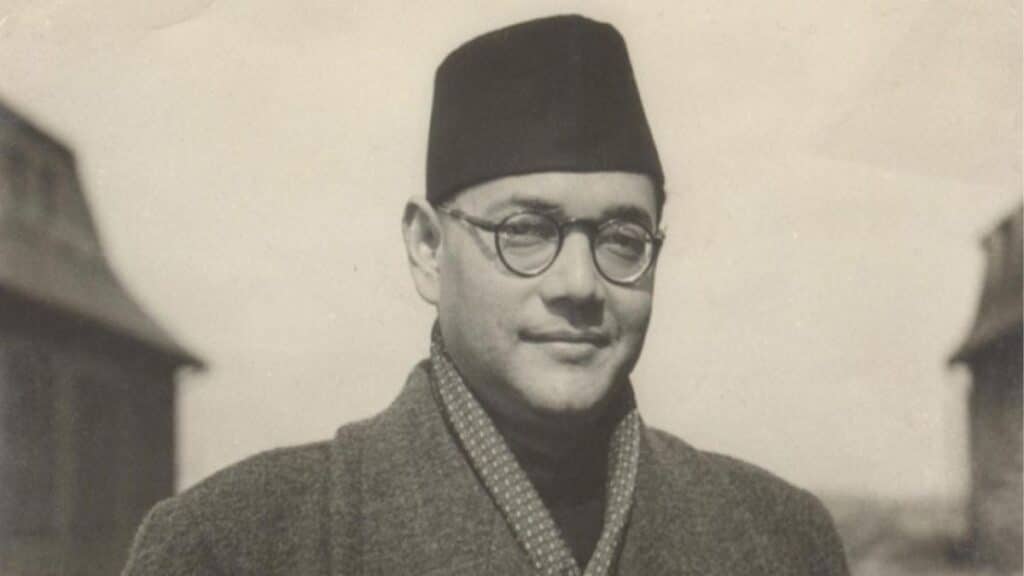
“Give Me Blood, and I Shall Give You Freedom”
This battle cry, delivered in various forms throughout Bose’s INA leadership, captures his revolutionary philosophy completely. It rejected passive resistance, demanded active sacrifice, promised liberation through struggle rather than moral persuasion. Where Gandhi asked Indians to suffer violence without retaliating, Bose asked them to inflict violence if necessary to achieve freedom.
The slogan’s power lies in its directness. There’s no room for interpretation, no philosophical nuance, no conditions. You give blood—your life, your sacrifice, your willingness to die. In return, you get freedom—immediate, total, uncompromising. It’s a transaction based on courage, not negotiations based on moral superiority.
The context makes the slogan even more significant:
- Delivered to INA soldiers and Southeast Asian Indian diaspora who’d already sacrificed everything
- Represented alternative to Congress’s “Quit India” movement happening simultaneously
- Promised agency—you could actively fight for freedom rather than passively resist
- Acknowledged freedom’s cost honestly, without romanticizing non-violence or minimizing British brutality
- United people through shared willingness to sacrifice rather than shared suffering
Modern India references this slogan during moments demanding national sacrifice or unity—whether soldiers at borders, pandemic frontline workers, or economic reforms requiring short-term pain for long-term gain. It’s become shorthand for demanding contribution, for reminding citizens that freedom and prosperity aren’t free but earned through collective effort.
For young Indians especially, the slogan resonates differently than Gandhi’s “Be the change you wish to see.” Bose’s call is urgent, demanding immediate action. Gandhi’s is contemplative, requiring internal transformation. Both have their place, but in moments of crisis or when radical change feels necessary, Bose’s militant energy often feels more appropriate.
Netaji’s Vision: Political Freedom Plus Economic Independence
What’s often overlooked in celebrating Bose’s military resistance is his broader vision for independent India. He wasn’t just fighting to replace British rulers with Indian ones—he wanted fundamental socio-economic transformation, a classless society, planned industrial development, and genuine economic sovereignty.
Bose’s writings and speeches reveal someone influenced by socialist ideas, critical of capitalism’s inequalities, skeptical that political independence alone would improve ordinary Indians’ lives. He advocated for state-led planning, nationalization of key industries, land reforms, and policies protecting workers and peasants from exploitation.
Bose’s vision for free India included:
- Strong central government capable of rapid industrialization and modernization
- Land redistribution to eliminate zamindari system and empower cultivators
- State control of major industries, banks, and infrastructure
- Universal education and healthcare as state responsibilities
- Rejection of caste hierarchy and commitment to social equality
- Disciplined, organized society prioritizing collective good over individual profit
This vision diverged sharply from what independent India actually became under Nehru’s leadership—parliamentary democracy, mixed economy, non-aligned foreign policy. Bose’s authoritarianism (he led Azad Hind Government as Head of State, Minister of War, and Minister of Foreign Affairs simultaneously) would’ve produced very different political structures.
Whether Bose’s India would’ve succeeded is impossible to know. His admirers argue he’d have built a stronger, more assertive nation unconstrained by democratic slowness. Critics note that his alliance with fascist powers, his comfort with authoritarian leadership, and his emphasis on militant nationalism could’ve produced outcomes far less democratic and pluralistic than what India became.
For diaspora conversations, this dimension of Bose’s legacy becomes complicated. Many Indians abroad appreciate democratic India’s freedoms, its pluralism, its ability to accommodate dissent. Bose’s vision, however inspiring regarding economic sovereignty and rapid development, raises questions about what might’ve been sacrificed to achieve it.
The Controversial Alliances: Why Bose Chose Axis Powers
This is where Bose’s legacy gets genuinely difficult. His collaboration with Nazi Germany and Imperial Japan—powers responsible for some of history’s worst atrocities—troubles even his admirers. How do you celebrate a leader who allied with Hitler and Tojo to fight the British?
Bose’s defenders argue “the enemy of my enemy is my friend” pragmatism. Britain was India’s oppressor; Germany and Japan opposed Britain; therefore, tactical alliance made strategic sense. They note Bose had no involvement in or responsibility for Nazi genocide or Japanese war crimes, that he was using Axis support purely for India’s liberation.
The reality is more complex:
- Bose met Hitler in 1942 and received promises of support for Indian independence
- He broadcast radio programs from Germany criticizing British imperialism
- He traveled to Southeast Asia in a German submarine, then Japanese aircraft
- The INA fought alongside Japanese forces, enabling Japan’s Burma campaign
- He accepted Japanese funding, weapons, and logistical support despite their brutal occupation policies
Critics argue that Bose’s willingness to ally with fascism reveals moral blindness, that fighting one imperialism by enabling another wasn’t liberation but switching masters. They note that Japanese occupation in Southeast Asia was horrifically brutal, that Nazi ideology was fundamentally racist, that these weren’t temporary alliances but active collaboration.
Bose apparently believed India could maintain independence even after helping Axis powers win. He may have underestimated Hitler’s racism or overestimated his own leverage. He definitely prioritized immediate tactical needs (fighting British) over long-term strategic concerns (what Axis victory would mean globally).
Modern Parakram Diwas celebrations rarely engage this complexity honestly. Official narratives emphasize his courage and dedication while minimizing the alliances that enabled his military resistance. For diaspora families especially, explaining to children that their cultural hero worked with Hitler requires navigating uncomfortable historical truths.
Comparing Bose and Gandhi: Two Paths to Freedom
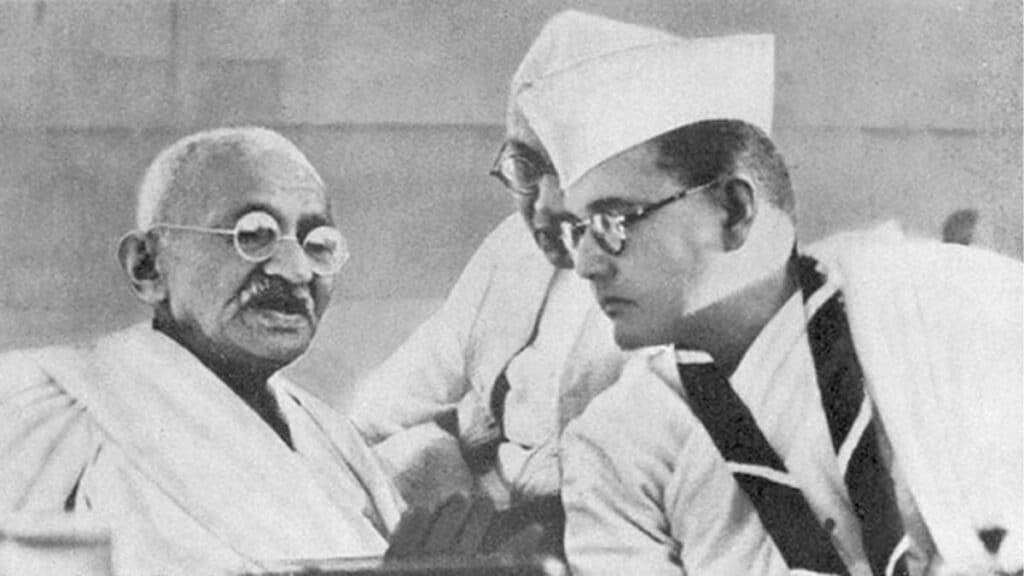
The Gandhi-Bose contrast represents Indian independence movement’s fundamental ideological split. Both wanted freedom. Both made enormous sacrifices. Both inspired millions. But their methods and visions couldn’t have been more different.
Gandhi believed moral force could shame the British into leaving, that suffering injustice without retaliation revealed oppression’s immorality. He organized mass civil disobedience—salt marches, non-cooperation, boycotts—designed to make India ungovernable without violence.
Bose believed the British would leave only when forced, that moral arguments meant nothing to an empire built on exploitation. He organized armed resistance—training soldiers, planning military campaigns, seeking alliances that could provide weapons and support.
The key differences:
| Aspect | Gandhi | Bose |
|---|---|---|
| Method | Non-violent resistance, civil disobedience | Armed struggle, military organization |
| Alliances | Moral persuasion, international sympathy | Tactical alliances including Axis powers |
| Timeline | Patient, willing to wait for moral victory | Urgent, demanding immediate action |
| Post-independence vision | Decentralized, village-based economy | Industrialized, centrally planned economy |
| Leadership style | Moral authority, consensus-building | Charismatic authority, decisive action |
History proved both approaches contributed to independence. Gandhi’s non-violence maintained moral high ground, prevented communal violence during the movement, created mass participation impossible through militant means alone. Bose’s INA, though militarily unsuccessful, convinced the British that Indian loyalty couldn’t be assumed, that their Indian Army might defect if push came to shove.
The 1946 Royal Indian Navy mutiny, partly inspired by INA trials, showed Bose’s impact. Sailors refusing orders, Indian soldiers questioning loyalty to the Crown, police hesitant to fire on protesters—these weren’t results of non-violence but of militant nationalism Bose represented.
The Mystery of Netaji’s Death
No discussion of Bose is complete without addressing the mystery that defines his legend—did he really die in that 1945 plane crash, or did he survive and live in secrecy for decades afterward?
Official version: On August 18, 1945, Bose died from third-degree burns after his overloaded Japanese bomber crashed in Taiwan while taking off. His body was cremated; ashes were preserved in Tokyo’s Renkoji Temple.
Alternative theories: Bose survived the crash (or there was no crash), escaped to the Soviet Union, lived under assumed identity, possibly as a sadhu in India. Various commissions investigated these claims, including the Shah Nawaz Committee (1956), Khosla Commission (1970), and Mukherjee Commission (2005).
Why the mystery persists:
- No British, American, or Chinese records confirm the crash, raising authenticity questions
- Taiwan authorities have inconsistent accounts of the incident
- Bose’s family, including brother Suresh, never accepted the crash explanation
- Reports of a mysterious sadhu called Gumnami Baba in Uttar Pradesh who resembled Bose
- Declassified documents showing surveillance of Bose’s family continued years after 1945
The Mukherjee Commission concluded in 2005 that Bose didn’t die in the 1945 crash, but the government rejected its findings, maintaining the official version. In 2016, declassified files revealed surveillance but didn’t resolve the death mystery.
For Bose’s admirers, the mystery adds tragic dimension—a hero who sacrificed everything, possibly lived in forced anonymity, never got to see the India he fought for. For skeptics, it’s conspiracy theory fueled by wishful thinking and refusal to accept that heroes die like ordinary people.
The diaspora relationship with this mystery is particularly interesting. Many Indians abroad hear family stories about Bose’s “real” fate, theories passed down generations, convictions that official history can’t be trusted. Whether true or not, the mystery keeps his legend alive, makes him feel unfinished, leaves room for continued discovery and debate.
Why Parakram Diwas Matters for Indian Identity Today
India in 2026 faces questions Bose would recognize—how assertive should the nation be internationally, how much state control over economy is appropriate, what balance between individual rights and collective good makes sense, how to achieve rapid development while maintaining democratic values.
Parakram Diwas keeps these questions alive by celebrating a leader who chose decisive action over endless deliberation, who prioritized national sovereignty over international approval, who believed some goals justified extraordinary measures. For an India increasingly confident on the world stage, frustrated with slow bureaucracy, demanding rapid transformation, Bose’s spirit resonates powerfully.
Modern relevance of Bose’s legacy:
- His emphasis on self-reliance echoes in “Atmanirbhar Bharat” (Self-Reliant India) campaigns
- His militant nationalism influences assertive foreign policy and border management
- His vision of strong central authority appeals to those frustrated with federal complexities
- His focus on economic independence informs skepticism toward foreign investment dependence
- His willingness to make hard choices resonates during crisis moments requiring sacrifice
But his legacy also warns against dangers—alliances with problematic powers for tactical gain, authoritarian tendencies justified by national emergency, militarization of political culture, sacrificing democratic process for efficient decision-making.
For diaspora Indians especially, Parakram Diwas becomes occasion to reflect on what kind of India they want to maintain connection with. An India inspired by Bose’s courage and determination, or warned by his controversial choices? An India that celebrates his vision while learning from his mistakes?
The answer, probably, is both. Heroes don’t have to be perfect to be worth honoring. Bose’s complexity—his brilliance and blind spots, his courage and questionable alliances, his vision and authoritarian instincts—makes him more human, more relevant, more valuable as historical figure than sanitized hagiography would allow.
Celebrating Parakram Diwas Meaningfully
As January 23, 2026 approaches, how should families, communities, and individuals engage with Subhas Chandra Bose Jayanti in ways that honor his contributions while grappling honestly with complexities?
Start with the facts. Read actual history, not just social media tributes. Understand what Bose accomplished, what he attempted, where he succeeded, where he failed. Introduce children to his story without erasing the difficult parts—they can handle nuance better than we assume.
Ways to observe Parakram Diwas meaningfully:
- Watch documentaries like “Netaji: The Lost Hero” or read biographies by serious historians
- Visit Netaji museums in Kolkata or other cities if possible
- Organize community discussions about his vision for India and its relevance today
- Compare his approach with other freedom fighters—understand the independence movement’s diversity
- Reflect on the question: what would you sacrifice for freedom or a cause you believe in?
- Support institutions preserving independence history and declassifying remaining files about Bose
For diaspora families, this could mean connecting with organizations researching Bose’s Southeast Asian legacy, exploring how he mobilized Indian communities abroad, understanding that diaspora political activism has deep historical roots.
It could mean having honest conversations about nationalism—when is it healthy pride in heritage versus when does it become problematic? Bose’s alliances with Axis powers offer real-world case study in how nationalist goals can justify troubling means.
Most importantly, it means recognizing that Parakram Diwas isn’t just government holiday or social media trend. It’s annual reminder that freedom required sacrifice, that multiple approaches contributed to independence, that the leaders we celebrate were complex humans who made difficult choices in impossible circumstances.
Bose gave everything for India’s freedom—his career, his family life, possibly his life itself. That deserves remembrance. But remembering doesn’t require uncritical celebration. The most meaningful way to honor him might be engaging seriously with the questions his life raises about courage, compromise, nationalism, and the price of freedom.
