


Imagine regaining your eyesight not through a cornea transplant or laser correction, but with the help of one of your own teeth. This is not science fiction—it’s the tooth-in-eye surgery, medically known as Osteo-Odonto-Keratoprosthesis (OOKP). This extraordinary procedure has transformed the lives of patients who once had no hope of seeing again.
What Is Tooth-in-Eye Surgery?
Tooth-in-eye surgery is a highly specialized ophthalmic procedure designed for people with end-stage corneal blindness or severe ocular surface disease, where conventional corneal transplants have failed or are impossible. The operation involves using the patient’s own tooth as a base for an artificial corneal implant, allowing light to reach the retina and restore vision.
How the Procedure Works: A Two-Stage Marvel
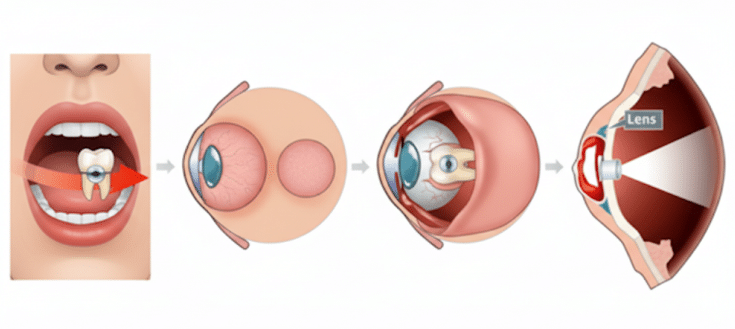
Stage 1 – Preparing the Eye and the Tooth
- Surface Preparation: Surgeons carefully remove scar tissue, damaged corneal layers, and the inner surface of the eyelids.
- Cheek Graft: A thin mucosal lining from the inside of the cheek is transplanted onto the eye’s surface to create a stable, vascularized bed.
- Tooth Harvesting: A canine or premolar tooth—along with part of its surrounding bone and ligament—is extracted.
- Implant Fabrication: The tooth-bone complex is shaped into a small lamina (plate) and drilled to hold a clear plastic optical cylinder.
- Cheek Incubation: This tooth-cylinder complex is implanted under the patient’s cheek for several months to develop a blood supply.
Stage 2 – Restoring Sight
After about four months:
- The cheek graft over the eye is opened and the internal eye contents removed.
- The tooth-cylinder implant is retrieved from the cheek and carefully positioned in the eye.
- The mucosal lining is replaced over the implant, allowing light to pass through the optical cylinder—enabling vision.
A Legacy of Innovation
The technique was pioneered in the 1960s by Italian ophthalmic surgeon Professor Benedetto Strampelli, one of the world’s early champions of intraocular lens implantation. His creative use of dental tissue revolutionized the treatment of otherwise irreversible corneal blindness.
Conditions Treated
Tooth-in-eye surgery is reserved for the most challenging cases, such as:
- Chemical or thermal burns
- Stevens–Johnson syndrome
- Ocular cicatricial pemphigoid
- Multiple failed corneal grafts
- Severe trachoma or Lyell syndrome
Success Rates That Inspire Hope
- 10-Year Anatomical Survival: ~66% of OOKP implants remain intact.
- 2-Year Functional Vision (better than 20/400): Around 63% of patients maintain usable vision.
- Long-Term Stability: Some studies show 85% of patients retain an intact OOKP implant after 18 years, with visual acuity around 20/200 even at the 30-year mark.
These numbers are extraordinary given that these patients had no other surgical options.
Risks and Challenges
As with any complex surgery, OOKP carries risks:
- Laminar Resorption: The implanted tooth-bone lamina can thin or break down over time.
- Glaucoma: Elevated intraocular pressure is a known complication.
- Multiple Surgeries: Some patients may require adjustments or replacements over decades.
However, with careful follow-up and experienced surgical teams, these risks can be managed effectively.
Prevention and Preparation: Protecting Your Eyes
While OOKP offers a second chance at sight, prevention of severe eye damage remains vital:
- Eye Safety First: Wear protective eyewear when handling chemicals or working in high-risk environments.
- Prompt Medical Attention: Seek immediate care for severe infections, burns, or injuries.
- Regular Check-Ups: Chronic conditions like dry eye or autoimmune disorders can lead to corneal scarring if untreated.
The Future of Vision Restoration
Researchers continue to refine OOKP techniques, exploring bioengineered scaffolds and less invasive alternatives. Yet, the original concept—using living tissue to host an artificial lens—remains a testament to human ingenuity and medical creativity.
The tooth-in-eye surgery is more than a medical procedure—it’s a miracle of modern medicine. For patients who believed blindness was permanent, Osteo-Odonto-Keratoprosthesis offers a powerful, life-changing solution.
If you or a loved one faces untreatable corneal blindness, consult an experienced ophthalmic surgeon to explore whether this groundbreaking procedure could restore your vision and transform your life.
