


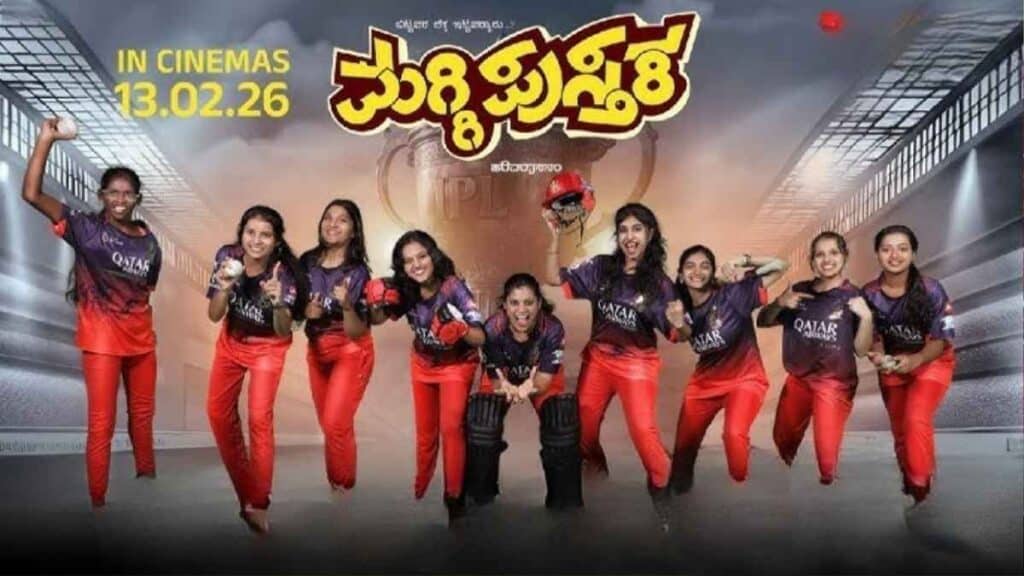
Kannada cinema has long served as a platform for socially conscious storytelling, addressing issues that mainstream commercial cinema often avoids. Maggi Pusthaka, releasing on February 13, 2026, continues that tradition with a thought-provoking examination of the Indian education system during the pandemic years.
For viewers seeking substantive, issue-driven cinema rather than escapist entertainment, Maggi Pusthaka offers a window into one of the most disruptive periods in modern Indian education.
Maggi Pusthaka (2026) is a Kannada drama (UA 16+, 2h 44m) based on a novel and true events, examining education system challenges during the pandemic. Krishna Mahesh and Girija Lokesh lead the cast. Budget: ₹1 crore. Opening day: ₹0.2 crore. OTT: Amazon Prime (date TBA). Rated 3/5 for earnest social commentary despite predictable plotting.
Table of Contents
What Is Maggi Pusthaka About? Plot and Themes
Maggi Pusthaka draws its narrative from both a novel and real-life events that occurred during the COVID-19 pandemic when India’s education system faced unprecedented disruption. Schools closed overnight, learning shifted online, and millions of students, teachers, and families struggled to adapt to a new reality they were unprepared for.
The film examines multiple dimensions of this crisis through interconnected storylines. It explores how students from economically disadvantaged backgrounds lost access to education entirely when learning required smartphones, laptops, and reliable internet — luxuries many families could not afford. It depicts the psychological toll on children isolated from peers and structure, the strain on parents suddenly expected to become home tutors while managing their own pandemic-related stress, and the ethical compromises teachers and administrators made as institutional pressures mounted.
COMPLETE MOVIE OVERVIEW
| Movie Title | Maggi Pusthaka |
| Release Date | February 13, 2026 |
| Runtime | 2 hours 44 minutes (164 minutes) |
| Genre | Drama, Thriller, Social Commentary |
| Language | Kannada |
| Age Rating | UA 16+ |
| Format | Theatrical release (2D) |
| Country | India |
| Industry | Sandalwood (Kannada Cinema) |
| Director | Harivarsanam Kanakapura |
| Writer | Harivarsanam Kanakapura |
| Producer | Chinnaswamy Ethiraj |
| Lead Cast | Krishna Mahesh, Raksha Gowda, Girija Lokesh, Mysore Ramanand, Bala Rajwadi, Padmaja Rao, Meghashree Kannadathi, Shobhraj, Ranjan Kasaragod, Ranvee Shekhar |
| Cinematography | Nandakumar Mysore |
| Music | Yashas Nachappa |
| Editor | Shivakumar Armugam |
| Budget | ₹1 crore (estimated) |
| Opening Day Collection | ₹0.2 crore gross (early estimate) |
| OTT Platform | Amazon Prime Video (date TBA) |
| Based On | Novel and true events related to education during pandemic |
| Setting | Karnataka (rural and urban contrasts) |
| Content Themes | Education system challenges, pandemic impact |
| Best For | Viewers interested in social issue films, Kannada cinema enthusiasts, educators |
Genre Breakdown: Social Drama Meets Thriller Elements
Maggi Pusthaka operates primarily as social issue drama but incorporates thriller elements that add urgency and tension to what could otherwise be a purely contemplative examination of education policy.
Drama: The Foundation of Social Commentary
Drama is the dominant genre, positioning the film within the tradition of Kannada cinema’s socially conscious storytelling. Films like Aachar (2023), which examined caste and education, and 777 Charlie (2022), which explored human-animal bonds and grief, demonstrate that Kannada audiences appreciate films that tackle serious subjects with emotional honesty.
Social dramas work by making abstract issues personal. Rather than lecturing about education policy failures, Maggi Pusthaka likely shows us specific families struggling to access online classes, specific students falling behind, specific teachers making impossible choices with limited resources. The drama emerges from watching characters we care about navigate systems designed without their needs in mind.
Thriller: Adding Urgency to Social Issues
The classification as Thriller alongside drama suggests the film incorporates elements of suspense, urgency, or high-stakes decision-making that go beyond typical social drama pacing. This could manifest in several ways:
Time pressure: Parents racing against deadlines to secure technology or resources for their children’s education, with real consequences if they fail.
Institutional conspiracy or cover-up: The “nuanced negative role” Krishna Mahesh plays could involve covering up systemic failures, manipulating data about student outcomes, or other ethically compromised actions that create thriller-like tension when threatened with exposure.
Four-Dimensional Novel-Based Cinema: What Does It Mean?
The description of Maggi Pusthaka as “four-dimensional novel-based cinema” is intriguing and suggests multiple interpretive layers working simultaneously:
Temporal dimension: The film likely moves between different time periods — perhaps contrasting pre-pandemic education with pandemic disruption and post-pandemic aftermath, showing how the crisis permanently altered educational trajectories.
Character dimension: Multiple interconnected character perspectives creating a mosaic view of the education crisis rather than a single protagonist’s journey.
Thematic dimension: Examining the education issue through multiple lenses simultaneously — economic inequality, technological access, pedagogical effectiveness, mental health impact, institutional accountability.
Narrative dimension: The novel basis provides literary depth while the true events grounding adds documentary authenticity, creating dual narrative modes that enrich each other.
The Cast: Krishna Mahesh and Girija Lokesh Lead Strong Ensemble
Krishna Mahesh in a Nuanced Negative Role
Krishna Mahesh takes on what is described as a “nuanced negative role,” which represents a departure from simplistic villain archetypes. In social issue films, the most effective antagonists are not evil people but ordinary people making compromised choices under systemic pressure.
His character likely represents someone within the education system — perhaps a school principal, education department official, or policy maker — who prioritizes institutional interests over student welfare. The “nuance” suggests we understand why he makes the choices he does even as we recognize the harm they cause. Perhaps he is protecting jobs and institutional reputation, operating under directives from superiors, or genuinely believing his actions serve a greater good even when they hurt vulnerable students.
Girija Lokesh as Familial Resilience
Girija Lokesh is a veteran Kannada actress with decades of experience playing mothers, grandmothers, and matriarchal figures. Her portrayal of “familial resilience” likely positions her as the emotional and practical anchor for a family navigating pandemic disruption.
This character would represent the millions of Indian women who held households together during lockdowns while managing remote learning for children, caring for elderly family members, dealing with job losses or health crises, and processing their own fear and grief. The resilience is not superhuman strength but rather the daily choice to keep functioning when everything feels uncertain.
Supporting Cast Adding Layers
Mysore Ramanand, Bala Rajwadi, Padmaja Rao, Raksha Gowda, Meghashree Kannadathi, and others populate the film with characters representing different positions within the education ecosystem. In ensemble social dramas, every supporting character should represent a specific perspective or stakeholder group — students, teachers, parents from different economic backgrounds, administrators, policy makers.
The strength of the supporting performances determines whether the film feels like a rich, complex examination of a multifaceted issue or a simplistic morality tale. Reviews praising their “measured contributions” and ability to “add layers” suggest the ensemble succeeds in creating a lived-in world.
CHECK MORE ON:Aashakal Aayiram Review: Audience Calls Jayaram-Kalidas Film a Feel-Good Family Entertainer
Director Harivarsanam Kanakapura’s Vision: Education as Social Justice Issue
Harivarsanam Kanakapura serves as both director and writer on Maggi Pusthaka, giving him complete creative control over the narrative and thematic execution. This writer-director approach often produces more cohesive visions because one person’s sensibility shapes every element from screenplay to final cut.
The screenplay is praised for maintaining “balanced pace” and integrating “emotional depth with subtle commentary.” This suggests Kanakapura avoids both the trap of preachy didacticism (where the message overwhelms the story) and pure melodrama (where emotion becomes manipulative rather than earned). Balancing social commentary with compelling narrative is difficult, and when done well, it produces the kind of cinema that stays with audiences long after they leave the theater.
These contrasts, when shown visually through cinematography rather than just explained through dialogue, make the inequality visceral and undeniable.
Box Office Performance: Modest Opening for Niche Regional Drama
Opening Day Collection and Early Estimates
Maggi Pusthaka opened on February 13, 2026 with an estimated gross collection of ₹0.2 crore (approximately ₹0.15 crore net). For context, this is a modest opening even for a low-budget regional film, but it aligns with expectations for niche social issue dramas releasing on a crowded Valentine’s weekend.
The film faced competition from larger releases including O’ Romeo and Funky, which likely secured more screens in multiplex chains, pushing Maggi Pusthaka primarily to single-screen theaters and select urban multiplexes in Karnataka. Advance bookings were subdued, with modest ticket sales in Bengaluru, Mysuru, and Mangaluru — Karnataka’s major urban centers.
Weekend and Lifetime Projections
Industry analysts project Maggi Pusthaka could earn ₹1-2 crore in its first three days (opening weekend) if occupancy improves through positive reviews and social media recommendations. A lifetime India net collection of ₹5-8 crore would represent success for this film, allowing it to recover its ₹1 crore budget and generate profit through theatrical, OTT, and ancillary revenues.
However, the film faces structural challenges in reaching even these modest targets. Social issue dramas, particularly those focused on recent traumatic events like the pandemic, require audiences willing to engage with difficult subject matter rather than seeking escapist entertainment. Valentine’s weekend traditionally favors romantic films and family entertainers, not serious dramas about education system failures.
Comparison to Similar Films
Relative to comparable Kannada films — smaller-scale dramas that opened at ₹0.5 crore or less — Maggi Pusthaka faces challenges expanding beyond core audiences. Films like Dollu (2022) and Pedro (2021) opened modestly but found legs through festival recognition and critical acclaim. Maggi Pusthaka may follow a similar trajectory if reviews emphasize its narrative integrity and social importance.
The worldwide gross projection of approximately ₹0.25 crore at launch reflects the film’s limited release footprint and niche appeal. Break-even against the ₹1 crore budget requires sustained performance over several weeks, which depends entirely on word-of-mouth and critical reception.
OTT Release on Amazon Prime Video: Digital Second Life
While theatrical prospects appear limited, Maggi Pusthaka’s digital future on Amazon Prime Video may prove more significant for its cultural impact and audience reach.
Amazon Prime Video has invested heavily in regional Indian content, recognizing that language-specific audiences are underserved by pan-Indian platforms. The platform’s Kannada library includes both commercial hits and content-driven films, making it a natural home for a socially conscious drama like Maggi Pusthaka.
The OTT release date has not been announced but typically follows theatrical release by 4-8 weeks for mid-budget regional films. On streaming, Maggi Pusthaka can find audiences who:
- Missed the limited theatrical release
- Are specifically seeking films about pandemic experiences
- Want Kannada-language content with social relevance
- Appreciate issue-driven cinema but do not frequent theaters
- Are educators, parents, or policy makers interested in the film’s themes professionally
Themes: Education, Inequality, and Pandemic Trauma
Maggi Pusthaka grapples with several interconnected themes that give its social commentary depth and relevance.
Digital Divide and Economic Inequality
The pandemic made visible what education advocates had long argued: access to quality education in India is profoundly unequal. When schools closed and learning moved online, students with smartphones, computers, high-speed internet, and educated parents able to help had minimal disruption. Students without those resources lost access to education entirely.
The film likely dramatizes this divide through specific families and their struggles. A rural student trying to attend online classes on a parent’s smartphone shared with siblings, squinting at a tiny screen with intermittent connectivity, cannot compete with an urban student attending classes on a dedicated laptop with stable WiFi. This is not a difference in intelligence or effort — it is structural inequality determining educational outcomes.
Institutional Failure and Ethical Compromise
The “nuanced negative role” Krishna Mahesh plays suggests the film examines how institutions failed students during the pandemic, often through actions that seemed reasonable from institutional perspectives but caused real harm to vulnerable individuals.
Schools and governments faced impossible choices: keep schools closed and accept that many students would fall behind, or reopen and risk virus transmission. Enforce strict online attendance policies that exclude students without technology, or relax standards and watch educational quality decline. Administrators, teachers, and officials making these decisions under pressure likely made compromises they were not proud of, prioritizing measurable metrics over harder-to-quantify human costs.
The film’s exploration of these ethical dilemmas adds moral complexity. It is easy to blame individuals; it is harder to examine systems that force impossible choices.
Family Resilience and Generational Burden
Girija Lokesh’s character representing familial resilience speaks to how Indian families, particularly women, absorbed the shock of pandemic disruption. Mothers and grandmothers became teachers, technology support, mental health counselors, and household managers simultaneously while managing their own stress.
The film likely shows this resilience not as triumphant heroism but as exhausting necessity. Families held together because they had no choice, and the cost of that resilience — in mental health, relationships, and individual wellbeing — deserves acknowledgment.
Pandemic as Revelatory Crisis
The pandemic did not create education inequality — it revealed and exacerbated existing problems. Maggi Pusthaka uses the pandemic as a lens to examine broader structural issues that persist beyond COVID-19. The digital divide still exists. Economic inequality still determines educational access. Institutional incentives still prioritize metrics over student welfare.
By grounding the story in pandemic experiences that audiences remember viscerally, the film makes arguments about education that might otherwise feel abstract or distant. We lived through this. We remember the fear, uncertainty, and improvisation. The film asks: what did we learn, and what are we doing to ensure vulnerable students are not abandoned when the next crisis hits?
Final Verdict: Earnest Social Commentary Worth Supporting
(4/5 Stars)
Maggi Pusthaka represents exactly the kind of socially conscious regional cinema that deserves audience support even when it does not achieve artistic perfection. This is a film made with genuine intentions to examine real problems, featuring capable performances and competent craft, addressing issues that matter deeply to millions of families who lived through pandemic education disruption.
What Works Well:
Timely, Important Subject Matter: The examination of education inequality exposed by the pandemic is relevant, necessary, and handled with seriousness and empathy rather than exploitation.
Strong Ensemble Performances: Krishna Mahesh’s nuanced negative role and Girija Lokesh’s portrayal of familial resilience anchor the film emotionally. Supporting cast adds genuine depth.
Balanced Social Commentary: The film avoids preachy didacticism while still making clear arguments about institutional failures and systemic inequality. Subtle rather than heavy-handed.
Authentic Foundation: Drawing from both a novel and true events gives the narrative dual authority — literary structure and documentary authenticity reinforcing each other.
What Limits Impact:
Predictable Plotting: Narrative developments follow familiar patterns, limiting ability to surprise or challenge audience expectations. Innovation in storytelling would strengthen social commentary.
Niche Regional Appeal: Focus on Karnataka-specific education dynamics and Kannada language specificity may limit crossover potential despite universal themes.
Substantial Runtime: 2h 44m is long even for Indian cinema standards, potentially testing patience of viewers not deeply invested in the subject matter.
Modest Production Values: Limited budget means the film cannot compete visually with larger productions, which may affect theatrical appeal even if it does not diminish thematic importance.
Best For:
Kannada cinema enthusiasts, educators and parents interested in pandemic education experiences, viewers seeking socially conscious regional cinema, audiences who value message over spectacle, supporters of low-budget independent filmmaking with social relevance, families looking for thought-provoking content suitable for teens and adults.
When did Maggi Pusthaka release?
Maggi Pusthaka released on February 13, 2026 in theaters.
What language is Maggi Pusthaka in?
The film is in Kannada language.
Who stars in Maggi Pusthaka?
The lead cast includes Krishna Mahesh, Girija Lokesh, Raksha Gowda, Mysore Ramanand, Bala Rajwadi, Padmaja Rao, and others.
