


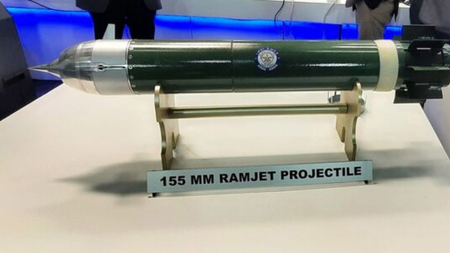
In a significant move towards military self-reliance, the Indian Army is poised to be the first armed force globally to use ramjet-powered artillery shells for its 155 mm guns. This development, part of India’s self-reliance campaign, is a collaborative effort with the Indian Institute of Technology (IIT) Madras. The innovation is expected to increase the range of conventional artillery shells by 30 to 50 percent while maintaining their destructive capabilities, representing a notable advancement in battlefield prowess.
Artillery modernization has been a key focus for the Indian Army, aiming to enhance the range and accuracy of munitions to meet modern warfare demands. While traditional artillery shells are potent, they have limitations in range and precision compared to advanced missile systems. By incorporating ramjet technology into 155 mm shells, the Army seeks to address this gap, enabling its artillery units to strike distant targets more effectively.
Ramjet propulsion, a well-established technology in missiles, is now being adapted for artillery shells. Unlike traditional engines, a ramjet is an air-breathing engine that does not require a compressor or turbine. Instead, it uses the projectile’s forward motion to compress incoming air. Once the shell reaches speeds around Mach 2, the ramjet activates, burning fuel in compressed air to generate thrust that sustains and extends the shell’s flight.
The project, led by IIT Madras in collaboration with the Army Technology Board (ATB), is currently undergoing developmental trials. Successful tests have already been conducted at the Pokharan field firing ranges in Rajasthan, demonstrating the feasibility of retrofitting ramjet modules onto existing 155 mm shells. This approach allows the technology to be integrated across the Army’s current artillery inventory without the need for entirely new ammunition designs.
The introduction of ramjet-powered artillery shells enhances the Indian Army’s capacity for deep strikes, disrupting enemy logistics and neutralizing fortified positions from safer distances. It also reduces reliance on costly missile systems for medium-range engagements, offering a cost-effective yet potent alternative. This development underscores India’s dedication to indigenous defense technologies and signifies a step towards reducing dependence on foreign suppliers while fostering innovation within the country’s academic and research institutions.
