


The US Embassy visa queue in Delhi isn’t where you expect miracles to happen. It’s where you stand clutching your folder, mentally reviewing your documents for the hundredth time, praying you haven’t forgotten anything critical.
For one O-1 visa applicant, that prayer went unanswered. Standing in an 8 AM queue that was already impossibly long, she realized she was missing documents—the kind Google flags as “kind of important for O-1 approval.” No time to leave. No nearby print shop. Just rising panic and a very long line ahead.
Then a security guard casually suggested: “Ma’am, just Blinkit.”
What happened next has become a viral testament to how India’s quick commerce infrastructure is solving problems nobody anticipated when these apps launched.
The US Embassy Incident: What Actually Happened
The viral story involves a woman applying for an O-1 visa—a highly specialized non-immigrant visa for individuals with extraordinary ability in sciences, arts, education, business, or athletics. The O-1 application process is notoriously document-heavy, requiring extensive proof of achievements, recommendation letters, employment contracts, and supporting evidence.
Standing in the Delhi US Embassy queue at 8 AM, she realized she was missing crucial documents. With no time to step out and a queue that was already impossibly long, leaving would have meant losing her interview slot entirely.
A guard’s casual suggestion to use Blinkit turned a potential visa disaster into a 15-minute wait. She uploaded her documents, paid for the prints, and had them delivered while still standing in the same spot. The visa was approved and stamped that day.
What makes this story resonate isn’t just the happy ending. It’s the casual ease with which a massive problem got solved—the security guard’s nonchalant suggestion, the app’s reliability, the delivery person navigating Delhi traffic to reach an embassy queue, all converging to prevent what could have been months of rescheduling and reapplication.
How Blinkit’s Print Service Actually Works
Blinkit, primarily known for delivering groceries and essentials in minutes, has quietly expanded into document printing services. The process is remarkably simple:
- Upload documents through the Blinkit app – PDF files of any document you need printed, whether it’s visa paperwork, certificates, contracts, or form submissions.
- Select print specifications – Choose between black-and-white (₹3 per page) or color prints (₹10 per page), select paper size, and specify single or double-sided printing.
- Choose delivery location – Enter your exact location, even if it’s not your registered address. The app works anywhere within Blinkit’s serviceable areas.
- Receive in 10-15 minutes – A delivery partner arrives with your freshly printed documents, usually within the promised quick commerce window.
The pricing is genuinely reasonable. At ₹3 for black-and-white and ₹10 for color, it’s comparable to local print shops but with the added advantage of not having to leave wherever you are. For someone stuck in a visa queue, in a hospital waiting room, or at an airport, that convenience is priceless.
Check Out : Official Site
Why This Matters Beyond One Visa Story
The incident has sparked conversations about India’s quick commerce infrastructure in ways that go beyond grocery delivery statistics. Several themes emerged in the viral discussion:
India’s service infrastructure feels like a genuine advantage. For Indians living abroad, the incident highlighted something they often miss—the density and responsiveness of India’s service ecosystem. The casual suggestion from a guard, the app’s availability, the delivery person’s willingness to navigate to an embassy queue all reflect an infrastructure built around solving immediate problems.
Quick commerce is evolving beyond its original scope. When these apps launched, they promised groceries in minutes. But the infrastructure they built—local fulfillment centers, delivery networks, app interfaces—can serve many purposes. Document printing is just one unexpected use case that’s emerged organically.
Indians are finding creative solutions to system gaps. The ability to order document printing while standing in a visa queue isn’t something the app designers probably envisioned, but it’s exactly the kind of creative problem-solving Indians excel at. The infrastructure enables it; users imagine the possibilities.
Skepticism and celebration coexist. The viral post drew both amazement and skepticism. Some questioned whether it was marketing, others worried about data security, a few dismissed it as gloating. But the underlying service is real and verifiable—Blinkit’s print option exists in the app, the pricing is accurate, and similar stories have emerged from users in other high-pressure situations.
Other Situations Where Instant Print Helps
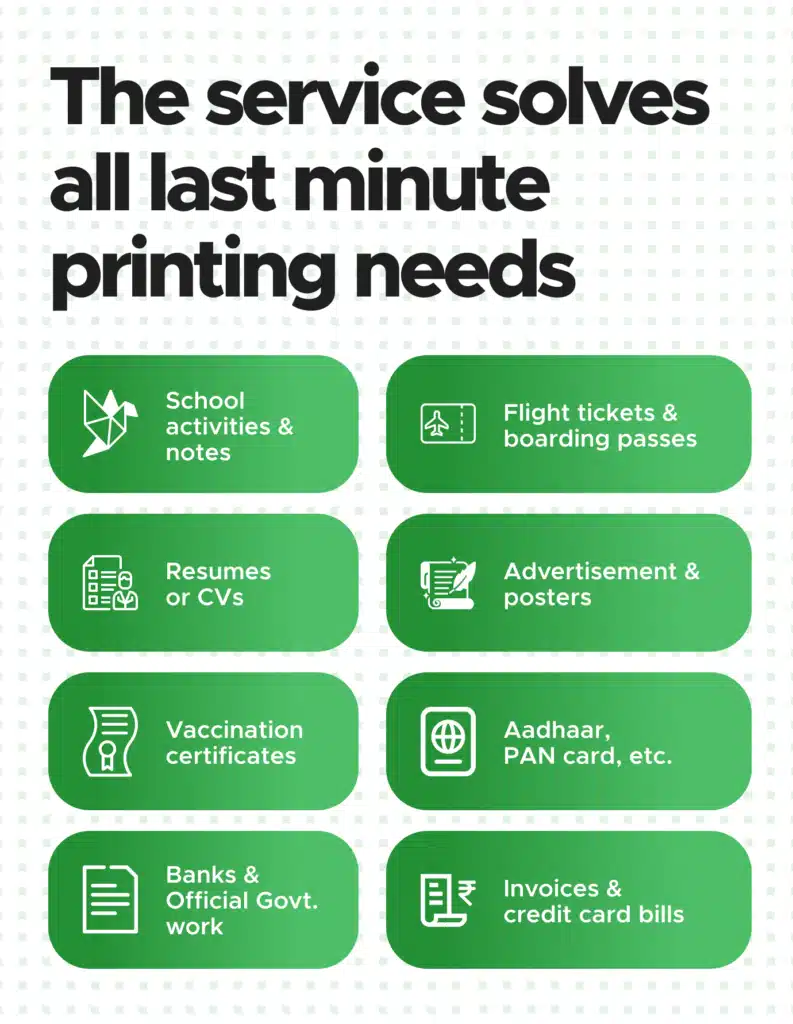
While visa queues make for dramatic stories, Blinkit’s print service is proving useful in less viral but equally important situations:
- Airport boarding pass emergencies – When you can’t get your boarding pass on your phone to load, or an airline insists on a physical copy, printing while in a cab to the airport has saved many flights.
- Hospital admission paperwork – Medical emergencies often require multiple form submissions, insurance documents, and identification proofs. Getting them printed while en route to or already at the hospital reduces stress during critical moments.
- Job interview document requirements – Some interviews still request physical portfolios, resume copies, or certificate submissions. Realizing this an hour before the interview used to mean panic; now it means a quick Blinkit order.
- Legal and government form submissions – Many government offices still require physical document submissions with specific formatting. The ability to print official forms at the last minute without searching for a print shop nearby saves substantial time.
- School admission paperwork – Parents juggling school admission processes know the struggle of surprise document requests. Being able to print additional forms, notarized copies, or supplementary documents without a dedicated trip makes the process less chaotic.
The common thread is situations where you need something printed right now, and leaving your current location isn’t practical or possible.
How Reliable Is the Service Actually?
Based on user experiences and service availability, Blinkit’s print service functions with the same reliability as their grocery delivery—which is to say, quite reliably within their serviceable areas.
Availability is city-dependent. The service works best in metros where Blinkit has dense dark store networks—Delhi NCR, Mumbai, Bangalore, Hyderabad, and other major cities. Smaller towns may not have the same coverage or speed.
Print quality is standard. Don’t expect high-end presentation printing, but for document purposes—visa paperwork, forms, contracts—the quality is entirely adequate. It’s regular printer paper with clear, legible printing.
Timing is usually accurate. The 10-15 minute window is generally met within serviceable areas. During peak traffic or weather disruptions, delays happen, but no more than with regular Blinkit deliveries.
Customer support handles issues. If there are printing errors, quality problems, or delivery delays, Blinkit’s customer support follows standard protocols—refunds, redelivery, or credits to your account.
The service isn’t perfect, but for emergency situations, it’s proven remarkably dependable.
Data Security Concerns Worth Considering
While the convenience is undeniable, uploading sensitive documents to a quick commerce app does raise legitimate questions about data handling and privacy.
Blinkit hasn’t publicly detailed document storage protocols. Unlike specialized document service platforms, there’s limited information about how long files are retained, whether they’re automatically deleted after printing, or what encryption protocols protect uploads during transmission.
Third-party delivery creates additional access points. Your documents pass through the app, the dark store where printing happens, and the delivery person transporting them. Each point represents potential exposure.
Not all documents should be treated equally. Printing a resume or cover letter carries different risk than printing passport copies, PAN cards, or financial documents. Users should assess document sensitivity before uploading.
For truly sensitive documents, traditional print shops where you physically oversee the printing might still be safer. But for time-sensitive situations involving standard paperwork, the risk-reward calculation often favors convenience, especially given India’s generally strong data protection consciousness among major apps.
The Bigger Picture: What India’s Quick Commerce Success Says
The Blinkit print service story is fascinating not just for its utility but for what it reveals about India’s unique position in the global quick commerce race.
India has leapfrogged many markets in quick commerce density and diversity. While Western cities debate whether grocery delivery in under an hour is feasible, Indian platforms are already solving problems several steps ahead—printing documents, delivering hot meals, providing pharmacy services, all in similar timeframes.
This isn’t happening because Indian technology is necessarily superior, but because Indian infrastructure and labor markets create conditions where high-touch, high-speed services become economically viable. Dense urban populations, relatively affordable labor, smartphone penetration, and digital payment adoption converge to make services possible that seem almost magical to people from less dense markets.
For the Indian diaspora, stories like the embassy print delivery carry extra resonance. They’re reminders of the infrastructure density back home, the casual problem-solving that’s woven into daily life, the way services bend to meet needs rather than expecting people to work around system limitations.
