


In this Sambhavam Adhyayam Onnu movie review, we explore a film that arrives like a quiet thunderclap in Malayalam cinema’s genre landscape. When was the last time a debutant director took Malayalam audiences somewhere they had genuinely never been before — not just a new story, but an entirely new kind of story? Sambhavam Adhyayam Onnu (The Incident: Chapter One) doesn’t just tell a mystery; it folds time itself into the narrative and asks the audience to hold on tight.
Debutant director Jithu Satheesan Mangalathu steps into feature filmmaking with a self-assurance that is rare and immediately impressive. He expands his own short film Sambhavam into a full-length feature — a task far more difficult than it sounds — and pulls it off with commendable craft. The film blends time-loop mechanics, alternate timelines, local mythology, and atmospheric forest horror into something that feels genuinely original for Malayalam cinema. Anchored by a grounded performance from Askar Ali and elevated by Naveen Jose’s eerily beautiful cinematography, this is the kind of film that reminds you why regional cinema at its best is unlike anything else.
Sambhavam Adhyayam Onnu is a rare, confident debut — an atmospheric mystery thriller that roots high-concept time-loop storytelling in authentic Kerala mythology. With a knockout interval twist, a committed ensemble cast, and technical craft that consistently impresses, this is essential viewing for fans of intelligent, genre-defying Malayalam cinema.
Language: Malayalam
Age Rating: U/A
Genre: Mystery, Thriller, Sci-Fi
Director: Jithu Satheesan Mangalathu
The Plot: When the Forest Doesn’t Let You Leave
At its core, Sambhavam Adhyayam Onnu is a mystery thriller — but calling it just that would be like calling the Kerala backwaters “some water.” The film’s real genius lies in how it weaves time-loop mechanics into a distinctly local mythology, making something that could have felt borrowed from European arthouse cinema feel unmistakably, proudly Malayali.
The film opens with a gripping prologue set along the Kerala–Tamil Nadu border. Inside a dense forest at night, a foreign matriarch arrives to dispose of two bodies. One belongs to a young local woman. The other — her younger husband — mysteriously disappears before it can be dumped. It is a short sequence, but it immediately establishes something vital: this forest operates by its own rules.
The story then shifts to civil police officer Anand (Askar Ali), who has just received a punishment transfer to this exact remote border region — and his wife is heavily pregnant, making the timing catastrophic. Strange events stack up rapidly. A wounded officer named Peter is found near the forest. SI Reji (Vineeth Kumar) stumbles upon a dead body during a confrontation with a group of youths. And then a mysterious wireless distress call arrives — a man named Stephen, identifying himself as a police officer trapped near a crow-deity temple deep inside the forest.
The deeper Anand and his colleagues push into the investigation, the more time, memory, and reality begin to overlap and collapse. It all builds to a mid-point twist that genuinely earns its gasps and reframes everything that came before. The crow deity and its surrounding folklore are woven into the plot with real care, giving the time-loop concept a cultural identity rather than making it feel like an imported premise dropped into a Kerala setting.
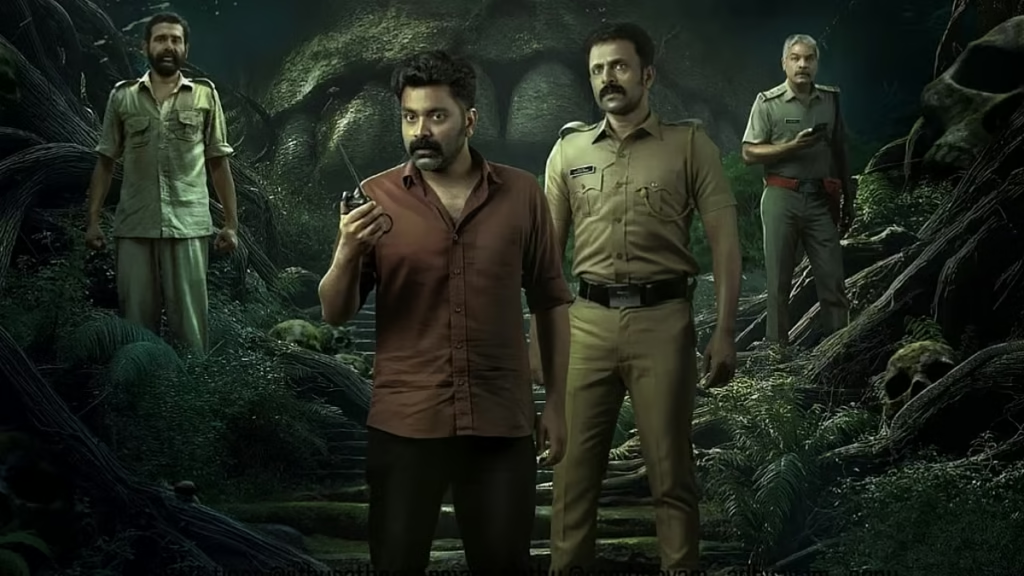
Performances: A Cast That Understands the Assignment
Askar Ali carries the film with quiet, assured authority. His Anand is a man under pressure from every direction — professional, personal, and increasingly supernatural — and Ali makes every layer of that pressure feel real. There is a stillness to his performance that keeps the film emotionally grounded even as the plot ventures into increasingly surreal territory. This is a role that demanded both physical conviction and emotional subtlety, and Ali delivers on both counts.
Vineeth Kumar is the film’s steady backbone. His SI Reji is measured, credible, and brings natural intensity to every scene he inhabits. Kumar is the kind of actor who makes everything around him feel more real, and his presence is one of the reasons the film’s stranger turns land as effectively as they do.
Sidharth Bharathan brings philosophical depth and quiet unpredictability to his role — a character who constantly challenges the audience’s assumptions about who is right and who is wrong. Every scene he appears in carries an extra charge of uncertainty that the film uses brilliantly.
Assim Jamal rounds out the ensemble with confident screen presence, adding intrigue and momentum to the central mystery. The supporting cast, without exception, understands the film’s tone and serves it well. Every character contributes meaningfully — no role feels like filler.
Direction: A Debutant Who Came Fully Prepared
Jithu Satheesan Mangalathu makes the kind of debut that immediately marks him as a filmmaker to watch. Expanding a short film concept into a feature is genuinely difficult — there is no template for it — but Jithu approaches the challenge with both ambition and intelligence.
His most important decision is anchoring the time-loop mechanics in Kerala’s border forest mythology rather than letting them float as abstract science fiction. The crow-deity temple becomes the narrative and spiritual centre of the story, and its presence gives the film a sense of place and cultural specificity that makes it feel original rather than derivative. This is someone who has studied the mechanics of genre filmmaking thoroughly and then found a way to make those mechanics distinctly his own.
The pacing in the early stretches asks for patience, but Jithu earns that patience fully in the second half. Once the interval twist lands, the film rarely lets go.
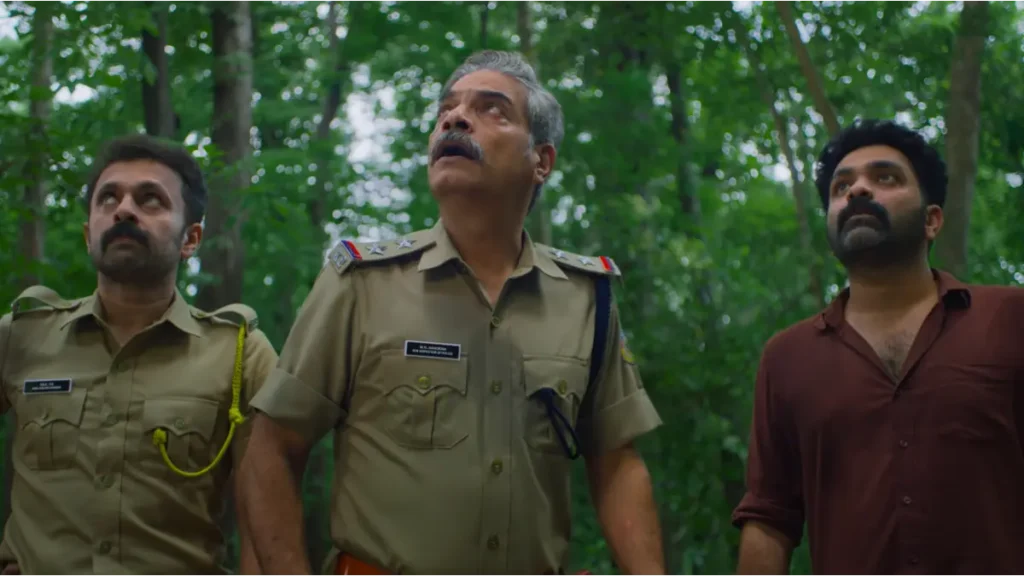
Technical Brilliance: Craft That Elevates Every Scene
The cinematography by Naveen Jose is one of the film’s quiet masterstrokes. The forest is rendered not as a backdrop but as a character — oppressive, layered, and deeply unsettling — without ever becoming visually monotonous. The use of shadow and controlled light sustains an atmosphere of unease that runs through the entire film.
The background score by Arun Raj is perfectly calibrated. Rather than announcing tension with swelling orchestral cues, the music seeps into scenes gradually, creating dread that feels earned rather than manufactured. The sound design amplifies this further, using the ambient sounds of the forest itself as a tool for disorientation.
Editing by Rathin Radhakrishnan handles a genuinely complex non-linear timeline with admirable clarity. The shifts between timelines are managed cleanly enough that the narrative never loses its audience, even when the story demands maximum ambiguity.
Strengths
- A Genuinely Original Premise for Malayalam Cinema — Time-loop thrillers are virtually unexplored territory here, and the film dives into the deep end with real conviction.
- The Interval Twist — A standout cinematic moment that reframes the entire first half and makes the second half feel like an entirely new film.
- Cultural Rootedness — Weaving the time-loop mechanics into Kerala border mythology makes this feel proudly regional rather than derivative.
- Sustained Atmospheric Craft — Cinematography, score, and sound design work in near-perfect concert throughout.
- A Committed Ensemble — Every performance serves the story. Everyone shines.
Areas to Keep in Mind
The deliberate early pacing, while purposeful and rewarding in retrospect, may test viewers expecting an immediately propulsive thriller. The emotional arcs surrounding Anand’s family and Reji’s personal story could have been developed a little further — the film’s human stakes are convincing but occasionally feel secondary to the plot mechanics. Minor inconsistencies in the time-loop logic exist for those who enjoy scrutinising such things, though they rarely interrupt the experience.
Final Verdict: 4.5/5 Stars ⭐⭐⭐⭐½
Sambhavam Adhyayam Onnu is exactly the kind of film Malayalam cinema needs — one that takes a genuine creative risk and delivers on it. Jithu Satheesan Mangalathu’s debut is atmospheric, surprising, and quietly confident in ways that linger long after the credits roll. Askar Ali’s grounded performance, the hauntingly effective craft work, and the film’s smart decision to root its high-concept premise in authentic Kerala mythology all combine into something genuinely memorable.
The title promises Chapter One. On this evidence, the chapters to come are something to be very excited about.
Now in theaters. Streaming on Amazon Prime Video from April 15, 2026.
What is the age rating of Sambhavam Adhyayam Onnu?
The film holds a U/A certificate, making it suitable for general audiences with parental guidance advised for younger viewers.
Can we watch Sambhavam Adhyayam Onnu with kids?
The film is best enjoyed by teenagers and adults. There is no explicit violence or adult content, but the complex narrative structure, eerie forest atmosphere, and time-loop mechanics are likely to be confusing or unsettling for younger children.
Is Sambhavam Adhyayam Onnu based on a true story?
No, the film is not based on a true story. It is an original work of fiction written and directed by Jithu Satheesan Mangalathu, expanded from his own earlier short film titled Sambhavam.
Where can I watch Sambhavam Adhyayam Onnu after its theatrical run?
The film is set to premiere on Amazon Prime Video on April 15, 2026.
